code · · 7 min read
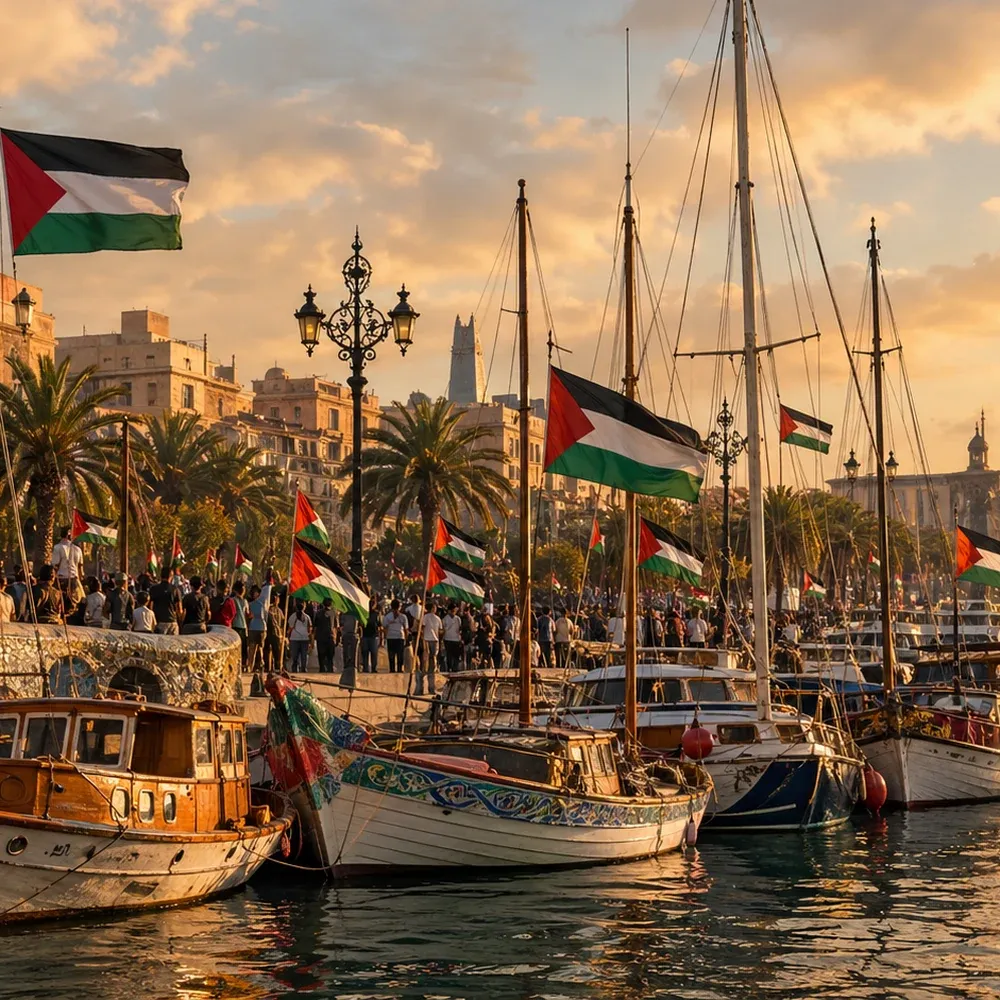
On the 12th of April, I stood on a harbour in Barcelona and watched seventy-something boats begin a journey I knew most of them would not complete.
The light was that particular Mediterranean gold that turns every mast into a silhouette and every flag into a banner. There were thousands of people on the dock: families, students, old couples, kids on shoulders, dock workers stopping on their way home. Ordinary Barcelona, turned out in full because they understood what they were seeing. Singing. Dancing. Standing at the railings with tears running down their faces, waving at strangers they would never meet.
It was joyous. It was hopeful. It was beautiful.
The boats were heading for Gaza. They were carrying about three thousand people from more than seventy countries. They were the largest civilian maritime mission ever attempted in the name of human solidarity. They had no weapons. They had food, medical supplies, a few journalists, and several hundred volunteers who had spent weeks training in nonviolent resistance and in how to be detained without escalating.
Nobody could tell them, with any certainty, what was waiting for them out there. They had read the history. They knew the risks. They didn’t know the outcome.
They went anyway.
The flotilla’s name comes from the Arabic word ṣumūd (صمود): steadfastness, the refusal to be erased. It is a Palestinian concept that emerged from the wreckage of 1967: the idea that you go on planting olive trees, raising children, loving and grieving and singing, even when a state with all the helicopters in the world insists you do not exist. Its symbol is the olive tree: rooted, patient, and very hard to kill.
The people on those boats were embodying that idea. They weren’t a charity. They weren’t a military operation. They were thousands of ordinary people refusing, quietly, deliberately, in international waters, to look away.
This wasn’t the first attempt. It was the latest in a tradition that goes back to August 2008, when two small boats called Liberty and Free Gaza sailed from Cyprus carrying forty-four civilians and reached Gaza, the first international vessels to do so in decades. Five flotillas reached Gaza between 2008 and 2016. They proved it was possible.
The defining moment came on the 31st of May 2010. Israeli commandos fast-roped from helicopters onto the Mavi Marmara, the largest ship in that year’s freedom flotilla, in international waters about 130 km from the Israeli coast. They opened fire on the civilians on board. Nine Turkish activists died on the deck that night. A tenth died later from his injuries. The ships were seized, the passengers held incommunicado, the footage confiscated.
The movement should have been crushed. It wasn’t. The Freedom Flotilla Coalition was formed within months, explicitly designed as a decentralised international network, so that the next attack could not kill the whole movement by killing one ship. Sixteen years later, that coalition has grown into the Global Sumud Flotilla: the FFC, the Global Movement to Gaza, the Maghreb Sumud Flotilla, and Sumud Nusantara from Southeast Asia, working as one.
These flotillas are organised as strictly nonviolent civilian missions. Participants train in nonviolent discipline before sailing. The cargo is humanitarian aid. Every interception has come from a single direction.
The official line, repeated by friendly governments and lazy news desks, is that these flotillas are PR stunts run by extremists. So it’s worth saying plainly who was on those boats.
Among them were healthcare workers, legal experts, journalists, humanitarian workers, organisers and artists. Doctors who had worked in Gaza and been blocked from going back. Lawyers on board to document what happens when a state intercepts civilians in international waters. Journalists on board because the alternative is letting a single side write the record.
The steering committee included Ada Colau, the former Mayor of Barcelona. Mandla Mandela, grandson of Nelson. Susan Sarandon. The largest national contingents were Turkish, Spanish, Italian, French, and Tunisian. Thirteen of them were British.
Whatever you want to call that, it isn’t a stunt. It’s a cross-section of the world’s conscience, the part that hasn’t yet learned to look away, packed into seventy sailboats.
On the night of the 29th of April, the IDF began intercepting them.
The interception happened in international waters, west of Crete, around 600 nautical miles from Gaza. By any sensible reading of the law of the sea, well outside any zone Israel has the legal authority to police.
They came in speedboats and drones. They jammed the flotilla’s communications. They pointed lasers and semi-automatic weapons at unarmed people and ordered them to kneel. Around 22 of 58 vessels were boarded. Roughly 175 people were detained at gunpoint. Boats were damaged or disabled. Some made it into Greek waters; with others, contact was lost.
The official Israeli justification is “enforcement of a lawful maritime blockade.” Their Foreign Ministry was reported to have dismissed the cargo as trivial. Condoms and drugs. The kind of phrase you only reach for when you have already decided the people on the receiving end don’t merit a serious sentence.
I want to be careful with the next word, because it matters.
What I watched yesterday was not bravery. A naval power with helicopters, drones, electronic warfare suites, and live weapons, surrounding sailboats full of doctors and grandmothers and journalists in international waters six hundred nautical miles from its own coast, and pointing guns at them. That is not bravery. There is no honest dictionary in which that word fits.
The bravery was on the other side. The bravery was in Barcelona, on the 12th of April, when three thousand civilians who had read the history of the Mavi Marmara, who knew exactly who was waiting for them and what would happen, untied the lines and went anyway.
Cowardice is what you call it when men with helicopters point guns at women on sailboats in international waters. The fact that the helicopters belong to a state and the sailboats don’t doesn’t change the picture. It just explains why it keeps happening.
I am not, as I said to a friend earlier today, doomscrolling. I am, and you are, if you’ve read this far, figuring out where to put the rage.
A few places it can go.
The Freedom Flotilla Coalition takes land volunteers: translators, medics, legal advisors, media specialists, logistics people. There are national campaigns in the UK that need bodies, money, and skills more than they need outrage. Donations to the GSF and the FFC flow through audited, registered structures; their financials are public. Writing your MP with the specific facts (international waters, six hundred nautical miles, the Mavi Marmara precedent, the legal status of the blockade under UNCLOS) lands harder than a general expression of horror. Local solidarity groups, faith communities, and trade unions can endorse the campaign formally, which adds institutional weight to the next mission.
And there will be a next mission. That is what sumud means. That is the entire point of the name.
I watched them leave. I watched them go anyway.
The question I’m sitting with tonight isn’t whether they were brave.
It’s whether the rest of us are.