code · · 7 min read
“Let everything happen to you: beauty and terror. Just keep going. No feeling is final.”
Rainer Maria Rilke, The Book of Hours, 1899
A young man, praying his way through the dark, before two world wars, before atomic weapons, before the internet, before any of this. And yet Rilke pinned something down so cleanly it still holds, maybe more tightly than ever.
I keep coming back to that line because I’m having trouble holding where I am in history.
The most powerful country in the world has elected a man who tried to overturn his last defeat, pardoned the mob who stormed the Capitol on his behalf, and has spent his second term openly musing about annexing Greenland, absorbing Canada as the 51st state, and taking the Panama Canal back by force. Not as a joke, not as a negotiating posture, but as stated intent. He has threatened to use the military against American citizens, floated a third term in a country whose constitution explicitly forbids one, and turned the Department of Justice into a personal grievance engine. He says all of this on camera, with his name on it, and roughly half the country either voted for it or decided it wasn’t disqualifying. Whatever word you reach for (fascist, autocrat, madman), the striking thing is that none of them is hyperbolic anymore. They’re just descriptive.
Israel is being led by someone whose political survival seems to require perpetual war, and whose government has levelled neighbourhoods, schools, hospitals, and universities in Gaza with a moral seriousness that would embarrass a demolition contractor. Tens of thousands of civilians dead, most of them women and children. An entire society of survivors now living in tents and rubble and the remains of what used to be their lives. A civilisation deliberately unmade in real time, livestreamed on our phones, while the people with the power to stop it keep sending more bombs.
In Moscow, a former KGB operative is grinding his way through a generation of Russian and Ukrainian young men to rebuild an empire that was never coming back. Two regional conflicts are burning. The global order that kept the peace, imperfectly and sometimes appallingly, for eighty years is visibly coming apart at the seams, and what’s replacing it looks very much like the nineteenth century with better missiles.
That’s one feeling.
Here’s the other.
I can sit at my desk tonight, type a sentence, and produce working software that would have required a small team and six months in 2015. I can describe an image and pull it from nothing. I can have a conversation at two in the morning with a machine that reads like literature. The tools of creation, the actual levers that made civilisation, have just been handed to anyone with an internet connection and an idea.
And here’s the part that undoes me, because it’s the same world I just described.
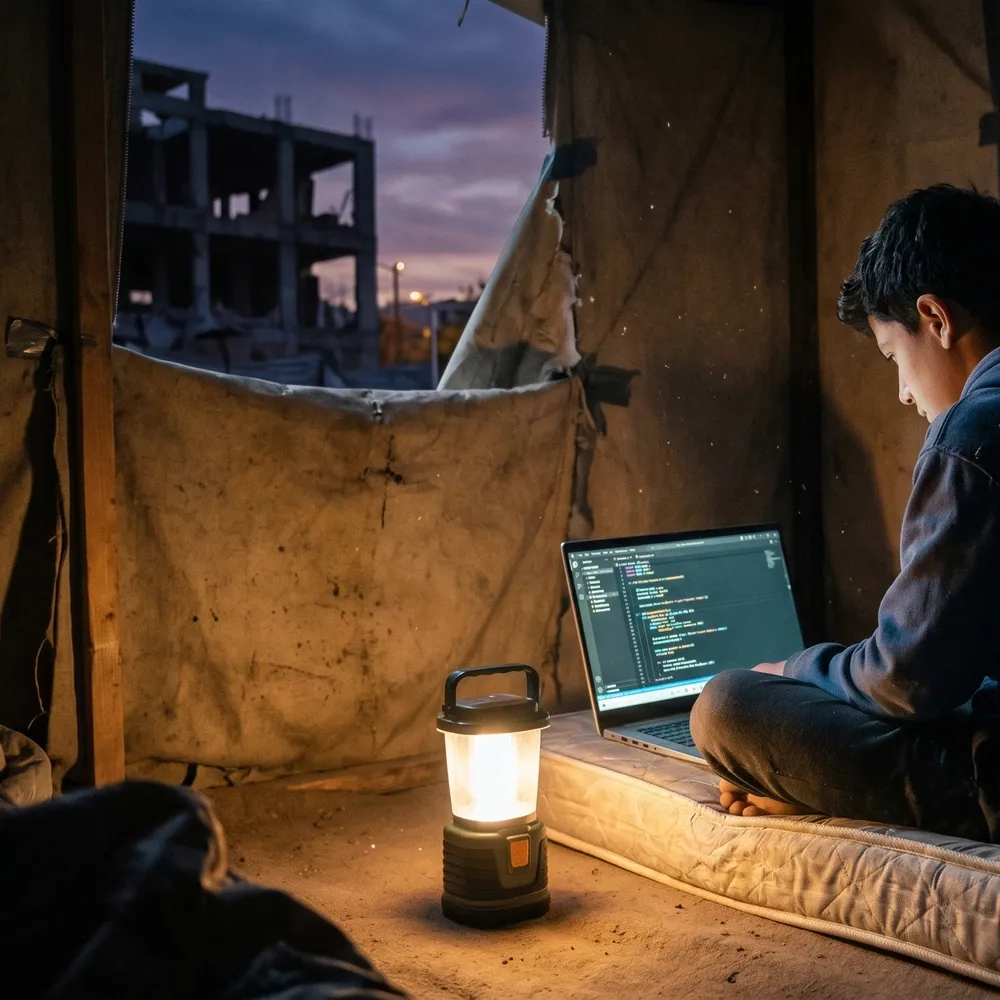
A teenager in a shelter in Gaza, whose school is gone, whose university is gone, whose family’s flat is a pile of concrete somewhere under a drone map, can still open a laptop and build software. Can learn to code over a weekend. Can ship an app by the end of the month. Can start a company from a tent with a twenty-dollar Claude subscription and a tethered phone. And people like me, sitting safely in the UK with electricity and a decent chair, can help them do it. Route around the rubble. Hand over the tools. Get out of the way.
I know this because it’s how I’m coping. We employ a Palestinian developer in the West Bank. We’re bringing another on from Gaza City through Gaza Sky Geeks. We’re in Tech for Palestine. I spend more of my week than I probably should boosting Palestinian builders, projects, founders. None of it stops a bomb. None of it brings anyone back. But it is the only thing that lets me read the news in the morning without going under. Building something, and helping someone else build something, turns out to be the only coping mechanism that holds.
The same six months that produced the rubble produced a generation of tools that mean the rubble doesn’t get the last word. A kid whose future was supposed to be erased now has, sitting in his hand, a creative toolkit more powerful than anything Silicon Valley had in 2019. His country has been destroyed. His classmates are dead. And he can still build. That is not a small thing. That is not cope. That is a live, weird, specific fact about this exact moment in history, and it refuses to fit tidily into either the “everything is fine” or “everything is over” story.
We are living through the most democratised burst of creative capability in human history, and almost nobody is talking about it that way because we’re all too busy doomscrolling the first paragraph.
Both of these things are true. At the same time. About the same places. About the same children.
That’s the vertigo.
The instinct is to pick one. Humans hate holding contradictions. It costs metabolic energy we evolved to hoard. So we resolve the tension artificially: either we become cynics (nothing matters, the tools are toys, the lunatics are winning) or we become evangelists (AI will solve everything, look away from the bodies).
Both are forms of cowardice. Both let you sleep.
Rilke’s line is the refusal of that shortcut. Let everything happen to you: beauty and terror. Not one. Not the other. Both. Don’t flinch from either. Don’t anaesthetise with either.
And then the part that saves you: No feeling is final.
This is not the glib “this too shall pass” you get on pub signs. It’s something much more surgical. It’s the observation that no emotional state is the permanent configuration of reality. Not the dread that grips you at 6am reading the news. Not the jolt of awe when something you made actually works. Feelings are weather. They move. The despair you’re feeling right now about Gaza, or Ukraine, or Washington, will not be the exact shape of the despair you feel in three months, or three years.
Neither will the joy. Neither will the purpose.
Just keep going.
There’s a reason this quote has outlasted a hundred years and a thousand Instagram reposts. Rilke understood something the Stoics understood, that the Buddhists understood, that every person who’s lived through something terrible and come out building something understood: you don’t transcend the bad by denying it, and you don’t earn the good by suffering stoically through it. You stay present to both. You let it pass through you. And you keep working.
The Renaissance happened during the Italian Wars. Shakespeare wrote Lear during a plague year. The Romantics wrote under Napoleon. Every creative explosion in history has happened in the teeth of something awful, because creative explosions are partly what humans do when things are awful. The urge to make is the urge to say: the world is not only this. The world is also this other thing I am now bringing into it.
If you are alive right now, you have been handed two things simultaneously: a ringside seat to democratic backsliding, genocidal war, and imperial revanchism; and the most powerful personal creative toolkit ever assembled, essentially for free.
The question isn’t which is more real. They’re equally real. The question is what you do inside the contradiction.
My answer, increasingly, is: both.
Witness the terror. Don’t look away from it, don’t pretend the tools will save us from it, don’t pretend some clever prompt will undo what a rocket does to a building.
And also, also, build. Make. Ship. Help someone. Use the absurd privilege of this moment’s toolkit to put something into the world that wasn’t there before. Every piece of real work done right now is a small vote against the nihilism the authoritarians are counting on. They need you tired. They need you numb. A person building a thing that helps another person is, in a small but literal way, their enemy.
So witness it. And build anyway.
Let everything happen to you: beauty and terror.
Just keep going.
No feeling is final.