code · · 7 min read
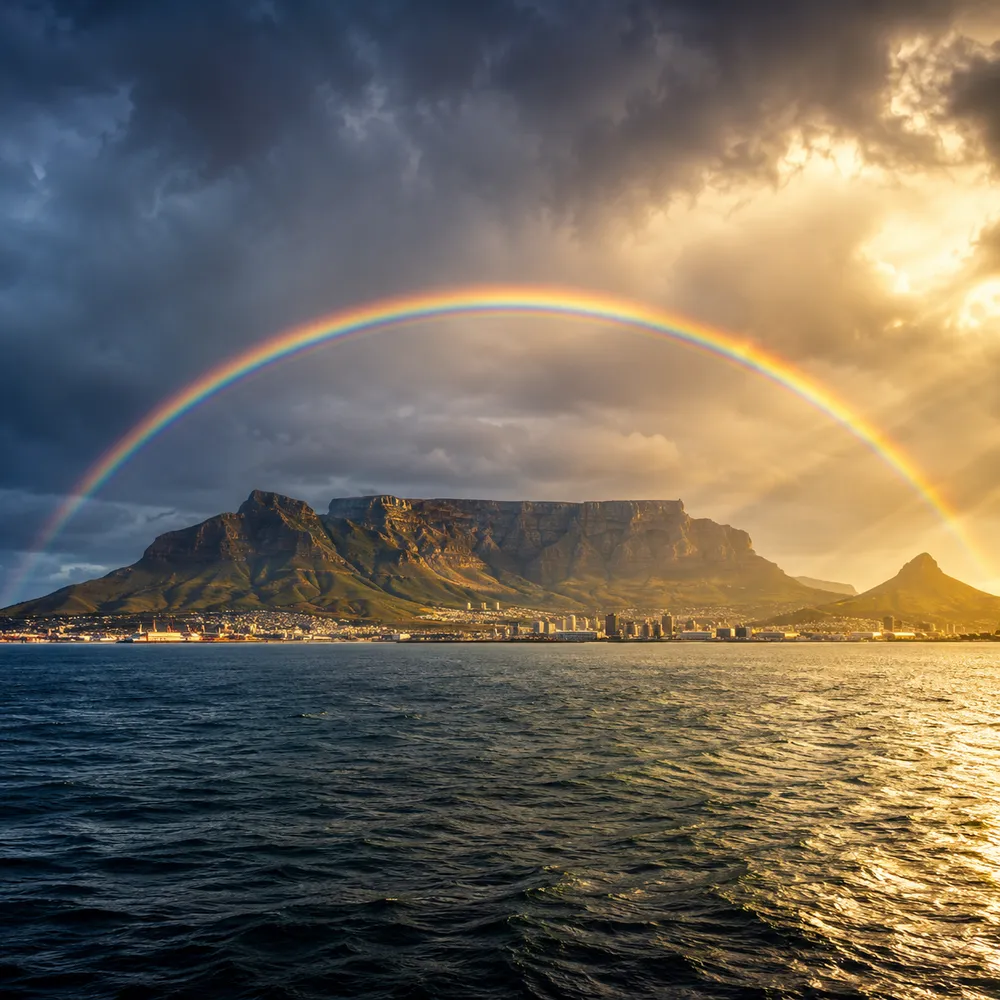
by Colin Domoney
On Saturday the 18th of July 2026, Mandela Day, I stood in an ordinary pub in South Africa and watched Black, white, Coloured and Indian South Africans sing the national anthem together. Arms around shoulders. Strangers hugging. Nobody organised it. Nobody needed to.
If you don’t know the South African anthem, here is the thing about it: it is a compromise document set to music. It stitches together the old liberation hymn and the old apartheid anthem, moving through Xhosa, Zulu, Sesotho, Afrikaans and English in under two minutes. It should not work. A committee designed it. And yet a pub full of people who would have been legally separated for most of my life sang every language of it, together, from memory.
To understand why that moment undid me, you need to know where this country was when I was young. Because I remember. I was born here in 1968, and I lived through the years when South Africa stood at the edge of the abyss and looked all the way down.
The first false dawn came in August 1985. The world had been told PW Botha would cross the Rubicon: real reform, maybe even Mandela’s release. Instead we got a finger-wagging, defiant speech that amounted to never. The rand collapsed. Sanctions tightened. The country settled in for the long dark.
By the late eighties the ground was shifting under our feet, though nobody said so out loud. There were rumours the government was talking to the ANC in exile. There were rumours that national service, the conscription every young white man faced, was going to be cut or scrapped. My mates and I watched blokes simply stop showing up for their call-ups, and watched the state quietly decline to do anything about it. When a government stops enforcing its own machinery of control, something is ending.
Then it ended fast. On the 2nd of February 1990, FW de Klerk stood up at the opening of parliament and unbanned the ANC. Nine days later Nelson Mandela walked out of Victor Verster prison, and that evening he addressed a vast crowd from the balcony of Cape Town’s City Hall. I remember being deeply moved by it: measured, dignified, utterly without bitterness after twenty-seven years inside.
What most people outside South Africa don’t remember is what came next. Not peace. The worst violence of my lifetime.
From 1990 to 1993, while Roelf Meyer and Cyril Ramaphosa kept the negotiations alive through sheer stubborn back-channel graft, the country burned around them. The fighting between ANC and Inkatha supporters turned commuter trains into abattoirs. I used to wake up to headlines about another train massacre, ordinary workers hacked and shot and thrown from carriages, sometimes by the hundred. And behind it all was the thing we called the third force: the widespread belief, later substantially confirmed by the Goldstone Commission and the TRC, that elements of the state’s own security forces were stoking the slaughter. There were stories that the police who arrived at a massacre scene in the morning were the same men who had committed it the night before, out of uniform. We lived with that knowledge like weather.
And then came the morning I will never forget. Saturday the 10th of April 1993. I was listening to Capital Radio when the news broke that Chris Hani had been shot dead in his driveway in Boksburg by a white far-right assassin. If you wanted to design a single act to tip South Africa into civil war, that was it: the most popular liberation leader after Mandela himself, murdered by exactly the enemy everyone feared. The whole country held its breath. I genuinely believed, that weekend, that we were going up in flames.
We didn’t. And the reason we didn’t is instructive. It was not the government that steadied the nation. It was Mandela, not yet president, going on television and calling for discipline and peace, pointedly noting that it was a white Afrikaner woman who had phoned in the assassin’s number plate. A prisoner of the state for twenty-seven years did the state’s job for it. Out of that near-collapse came the one thing that mattered: a locked election date.
On the 27th of April 1994 we queued, all of us, in lines that snaked for miles, and it was peaceful, and it was extraordinary. On the 10th of May Mandela was inaugurated. A year later he walked onto the pitch at Ellis Park in a Springbok jersey, the uniform of Afrikaner nationalism, and handed Francois Pienaar the World Cup, and the Rainbow Nation had its defining image. And then, because the wounds were real and could not be wished away, came the Truth and Reconciliation Commission: Tutu in the chair, thousands of victims and perpetrators testifying on live television, truth traded for amnesty. Imperfect, contested, incomplete. Also one of the bravest things any nation has ever attempted.
I wish I could tell you I stayed for the rebuilding. I didn’t.
The political transition succeeded and the social fabric tore anyway. As the old police state dismantled itself, violent crime exploded into the vacuum. By the late nineties I had been hijacked, shot at, held up at gunpoint, threatened at knifepoint, and burgled a dozen times. In 1999 I left, like so many others did. I’m not proud of it and I don’t apologise for it. It is simply part of the story, and an honest account includes it.
But I kept coming back. And here is what nobody who left ever quite expects: every single time I return, the country has moved. Not always forward in a straight line, never as fast as it should, but moved. The predicted collapse, confidently forecast at every dinner party in 1999, keeps failing to arrive. A generation has now grown up entirely free, and it shows in how they carry themselves.
On one of those returns, around 2016, I took my now wife and her two young children out to Robben Island. In the ticket hall at the Nelson Mandela Gateway there is a quote on the wall from Ahmed Kathrada, who spent eighteen years imprisoned on that island, about what he wanted the place to stand for: not a monument to suffering, but “a triumph of the human spirit against the forces of evil”. That is the choice this country made, deliberately, when it had every justification to choose vengeance instead. Standing in that hall with two children who would only ever know this history as history, waiting for a tourist ferry to what used to be the regime’s dungeon, you feel the size of that choice.
And then, on Mandela Day, the pub, and the anthem, and I stood there with a lump in my throat doing the maths: thirty-three years, almost to the season, since I sat by a radio convinced this country was about to devour itself.
I would be lying, though, if I told you only the good news.
South Africa is fighting a new fight now, and it is an ugly one. The hostility towards foreign African workers is not a fringe phenomenon; it is organised, it is emboldened, and this year it has turned openly violent. Vigilante movements have set deadlines for undocumented foreigners to leave. People have died in the mobs. Tens of thousands of Zimbabweans, Malawians and Mozambicans have fled homes and businesses. Children have been blocked from clinics for lacking the right papers. I saw the temperature of it myself these past weeks, and it is rife.
Yeats had a phrase for this. In The Second Coming he imagined the horror that follows collapse not as something new but as a rough beast slouching back towards us to be born again. South Africa knows this beast. It spent half a century under its rule: the pass checks, the papers demanded in the street, the sorting of human beings into those who belong and those who must be pushed out. That the beast now slouches through the townships wearing new clothes, speaking the language of the dispossessed rather than the dispossessor, does not change its gait. And if any nation on earth should recognise that gait, it is this one. The countries whose citizens are now being hounded are the same neighbours who sheltered the ANC in exile and paid for it in blood.
So my love letter comes with a caution attached: you did not come through the fire of the nineties to light this one. Do not go back down the dark route. You, of all people, know where it ends.
I’m leaving after three weeks with my perspective rearranged, and I want to set down four things before the feeling fades.
One: never tolerate racism. Ever. I never tolerated it as a white South African growing up under apartheid, and I am not about to tolerate it as a white Briton now. Every slur I hear, in a pub, in a comment thread, dressed up as banter or as concern about immigration, I will challenge, by name, to the person’s face. I do not care who I offend and I do not care what it costs me socially. Silence is how the window moves; I watched it move once and I know how it ends. This is the single non-negotiable my upbringing left me with.
Two: the oppressed can win. Watching what Black South Africans endured and overcame remains the most inspiring thing I have witnessed in my lifetime. Mandela and his generation faced a nuclear-armed police state, decades of prison, exile, assassination, and a world that was slow to care. They never gave up, and their persistence won them their freedom. Anyone anywhere who is subjugated should look at South Africa and take heart: the machine can be beaten.
Three: face forward. What struck me hardest these three weeks, amid brutal unemployment and everything else this country carries, is the sheer forward-looking energy of the place. Everyone is hustling, building, working the next angle, looking for the next opportunity. In three weeks I did not once encounter the culture of blame I have grown so used to in Britain, where every problem is the fault of the boat people or the last government or anyone but ourselves. Here, people who have every historical right to grievance are too busy building to wallow in it. It is refreshing beyond words, and it shamed me a little, in a useful way.
Four: leadership is not a management technique. In 1988 I watched Desmond Tutu address the students union at what was then the University of Natal, and I have not seen anything like it before or since. Here was a small Anglican cleric doing a job that was never meant to be his, because the men whose job it was were on Robben Island or in exile, and the pulpit was one of the last places left where you could say the thing out loud and survive saying it. It was proper fire and brimstone, and nobody in that hall left in any doubt about what was being asked of them. Then Mandela, who came out of twenty-seven years inside and chose reconciliation over the reckoning he was owed. We had both of them at the precise moment it mattered most. In this age of peak stupid, with a world stage bereft of anyone you would follow into a corner shop, I understand at last how privileged that was.
On his ninetieth birthday, calling the next generation to service, Mandela said “it is in your hands now”. That call is the reason the 18th of July became Mandela Day at all. It was in their hands, and look what they did with it. Now it’s in ours.