
life · · 5 min read
by Colin Domoney
Most of what I write here has stakes. This post has none. I have spent thirty years as a software and security engineer, and what I wanted to be was a DJ, or failing that an audio engineer. The nearest I got was headphones, which I have been quietly obsessed with since I was about twelve, and the handful of small engineering ideas that kept pulling me back to them across four decades and two continents. If you want something that matters, come back next week.
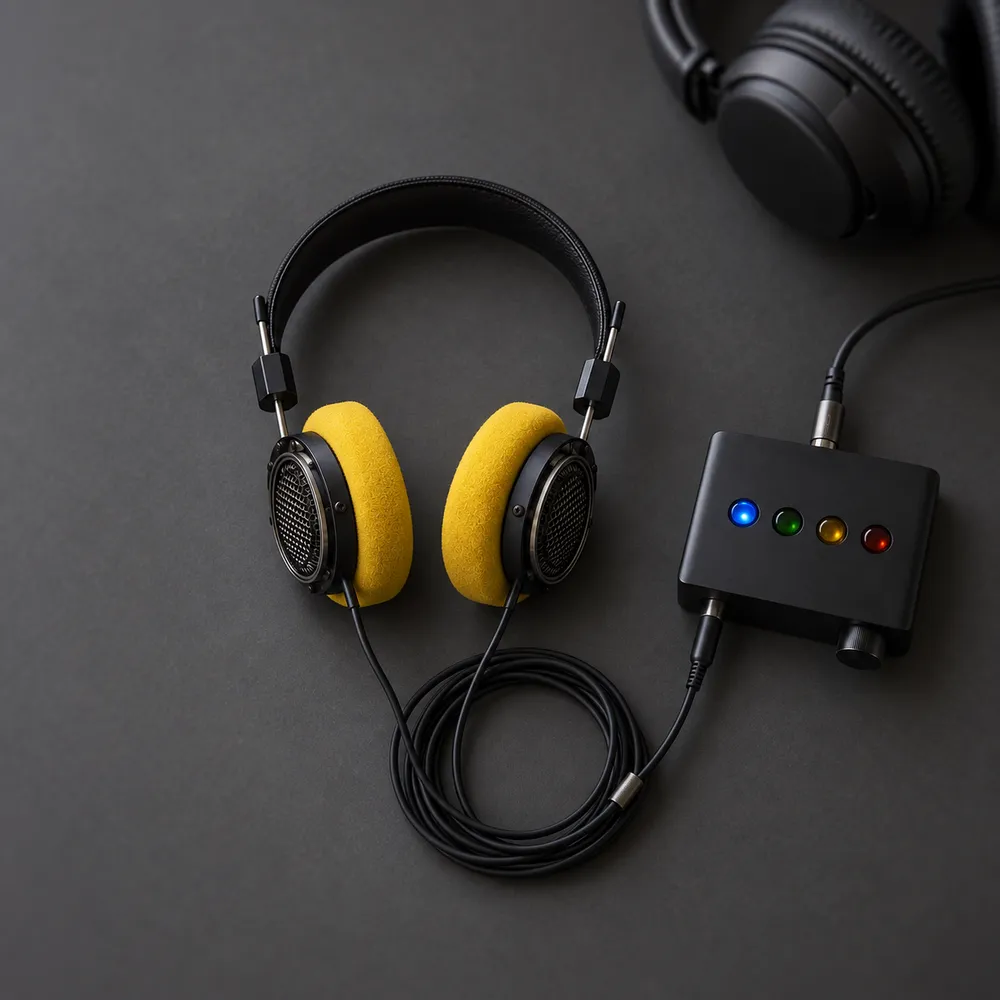
The first pair I would call proper were Sennheiser HD 414X. Black body, bright yellow foam pads, sitting on the ear rather than around it, and completely open at the back so the whole house could hear what you were listening to. The original HD 414 from 1968 was the first open-back headphone anyone had sold, and by the time the X variant reached a schoolboy in South Africa in the early eighties the family had shifted millions of pairs. You can still buy the yellow pads. Sennheiser has never stopped making them, which tells you something about how many are still in use.
At some point in that era I wrote a letter to Sennheiser in Wedemark. An actual letter, on paper, from a child on the wrong end of Africa. Some weeks later a box arrived with catalogues and brochures in it. Memory insists there was a pair of headphones in the box as well, but memory has had forty years to embroider that and I am not going to swear to it. What I am sure of is the shape of the thing: a German manufacturer answered a letter from a kid it would never sell anything to, and I have bought their products ever since. That is a marketing budget well spent.
Once I was earning real money the 414s gave way to the HD 580 Precision. These arrived around 1993, designed by Axel Grell as an attempt to bring the ideas from Sennheiser’s absurd electrostatic Orpheus down to a dynamic driver a mortal could afford. Open-back, around the ear this time, velour pads, the herringbone grille, made in Ireland. Everything Sennheiser has sold at the top of its dynamic range since (the 600, the 650, the endless 6xx variants) descends from that pair.
The catch was the impedance: 300 ohms. Plug them into a portable player and you get sound, but you do not get the headphone. They want voltage. So the 580s dragged me into amplifiers, and for a while into valves, which is a chapter I will spare you because everyone who has been through it tells the same story.
The more interesting purchase from that period was a separate DAC and headphone amplifier from HeadRoom, with a switch on the front that did something odd. That switch was crossfeed, and HeadRoom had built a whole business on it.
HeadRoom was founded in 1992 in Bozeman, Montana by Tyll Hertsens, a former scanning electron microscope repairman who spent far too much of his life on aeroplanes and had noticed that portable players could not drive decent headphones. His thesis went further than power. When you listen to a stereo recording on speakers, each ear hears both channels. The right ear hears the left speaker a fraction of a millisecond later than the left ear does, slightly filtered by the lump of head in the way. Every mix ever made for speakers assumes that leakage. Headphones sever it completely, each channel goes to one ear only, and the brain spends the whole session working out where the sound is supposed to be. Hertsens treated the resulting fatigue as an engineering problem rather than a fact of life.
The fix was an analogue circuit that fed a delayed, attenuated, high-frequency-rolled-off copy of each channel into the opposite ear. About four hundred microseconds of delay, a few decibels down, treble shaved off to mimic what a skull does. The idea was not his; Ben Bauer at CBS Laboratories had worked it out in the early 1960s and published the circuits. Hertsens rebuilt it with modern op-amps and put a switch on the front labelled Process, and the manual explained all of the above in language I can still nearly recite. Everyone who tries crossfeed says the same first thing, which is that the stage got narrower. It did. It also stopped giving you a headache after two hours. This is not surround sound and it is not a placebo. It is a small, honest piece of psychoacoustics that most of the industry ignored for thirty years.
The next chapter is not about sound at all. It is about silence.
Somewhere in the travel years I bought a pair of Bose QuietComfort 25s. Wired, one AAA battery, an inline remote, released in 2014. The first flight I wore them on with the cancelling switched on was a small shock. The engine drone simply went. Not quieter; gone. Aircraft cabin noise is mostly low-frequency rumble, which is exactly the region active cancellation handles best and exactly the region Bose had been chasing for decades.
The origin story is worth knowing because it explains why Bose owns the category in the public mind. In April 1978 Amar Bose was on a Swissair flight from Zurich to Boston, tried the airline’s headphones, found the cabin made them useless, and spent the rest of the flight sketching the maths for cancelling the noise. Prototypes flew on the Voyager round-the-world flight in 1986, a commercial aviation headset followed in 1989, and the first consumer pair, the QuietComfort 1, arrived in 2000. Sony had actually sold consumer noise-cancelling headphones in the mid-nineties, but nobody remembers that, and in this business the story you tell is worth more than the patent date.
The QC25 taught me one more thing when the AAA cell died somewhere over the Atlantic. The music carried on. The hush stopped. And I discovered how much of what I had been paying for was the hush.
Two years later the QuietComfort 35 appeared. Same face, same hush, but the cable was now optional and Bluetooth was in. I refused it on principle. I had spent real money on 300 ohm headphones and an amplifier with a psychoacoustic processor in it. Bluetooth audio was lossy compression squirted over a radio link designed for keyboards. Sacrilege.
I will not pretend the principle held. It held for about as long as it took me to notice everyone else on the plane had no cable to snag on the armrest.
In 2018 Sony released the WH-1000XM3 and the British hi-fi press lost its composure. Five stars everywhere. Richer Sounds had them in the window with the reviews printed out and stuck to the glass. I bought a pair on the strength of that and sat on the sofa somewhat dumbstruck.
It was not that Bose had failed. It was that Sony had finally matched enough of the hush, on a new QN1 processor of their own design, and then attached it to a headphone that sounded like a hi-fi company had built it. Thirty hours of battery, USB-C, an app with an equaliser in it. The XM3 is the point where reviews flipped from “Bose, obviously” to “just buy the Sonys.” Bose still edged the engine rumble; Sony won the music and the rest of the week. I went XM4, then XM5. The XM6 exists and I have not worn it, so I have nothing to say about it.
People find it odd that a conglomerate which lost phones and televisions to everyone should make the best travel headphones on the planet. It is not odd once you know the lineage.
In 1979 Sony shipped the Walkman TPS-L2, and in the box was a pair of lightweight headphones, the MDR-3, because there was no point in a personal cassette player without something personal to listen on. Masaru Ibuka wanted music on long flights. That product is where mass personal headphone listening starts. Sony did not join the headphone business; they invented the reason it exists.
The studio side is quieter but just as deep. The MDR-CD900ST, released in 1989, is still the default monitor in Japanese recording studios, and its export cousin the MDR-7506 is on the head of half the broadcast engineers you have ever met. In 1989 they made the MDR-R10, a zelkova-wood art piece priced like a small car, which tells you they thought of headphones as transducers to be taken seriously rather than accessories to fill a shelf. Their noise cancelling goes back to an aviation headset in 1992, consumer pairs in the mid-nineties, and the first digital cancelling headphone in 2008. The QN chips in the 1000X series are Sony silicon. And they own a record company, so the monitors the album was mixed on and the headphones you listen to it on are, quite literally, family.
As I understand it, around 2011 Sony decided to stop winning unit share with ten pound supermarket earbuds and build the brand from the top down instead. The 1000X line was the result, and the XM3 was where twenty years of cancellation work and a hi-fi lineage most people had forgotten about landed in one product. Headphones are the longest-running product Sony has never stopped making. The doldrums were elsewhere.
Which brings me to now, and to the odd fact that after twenty years of Bluetooth I have a cable on my desk again.
The front end is a WiiM Pro Plus. It is a streamer, nothing more: it finds the file and hands the bits out over optical. It has a perfectly decent DAC of its own that I never hear, because the signal leaves the box still digital. The WiiM is a plumber.
The conversion happens in a Chord Mojo 2, which is a CNC-milled aluminium pebble from Kent designed by Rob Watts, and it is the most interesting piece of electronics I own that does not run my own firmware. There is no off-the-shelf DAC chip inside it. The conversion is done by a pulse-array design running on an FPGA, with a reconstruction filter of 40,960 taps spread across 40 DSP cores. Watts also built what Chord calls a UHD DSP, a 104-bit core running at 705 or 768 kHz, which lets it apply a four-band equaliser in 18 steps per band with a claim of no audible loss. I am not equipped to argue with the claim. What I can say is that it does not sound like an equaliser.
And it has crossfeed. Four settings, selected by a glowing ball on the top. Bauer worked it out in 1961, Hertsens put it in a box in 1992, and Watts put it in an FPGA the size of a bar of soap. Thirty years after that switch marked Process, the same idea is back on my desk, and it still narrows the stage and still stops the headache.
There are two signal chains in this house now and they do not speak to each other. On a plane it is phone, Bluetooth, XM5, and Sony’s own DAC and cancelling doing the work inside the cups. At home it is WiiM, a length of TOSLINK, the Mojo 2, and a cable running to whatever is on my head. Two religions, one head.
If I had to compress forty years into a sentence: Bose taught me that cancellation was real. Sony taught me it could also be a headphone. The Mojo 2 was the admission that a cable still does something Bluetooth does not.
The yellow pads are still available. I checked.